N I G H T L I F E
How to Enjoy Shinjuku at Night: Golden Gai, Kabukicho & Izakaya Guide
Golden Gai etiquette, Kabukicho safety tips, Omoide Yokocho food, karaoke chains, and last train timing.
Quick Answer
- Start at Omoide Yokocho (west exit) for yakitori and beer around 6 PM → walk to Golden Gai (east side) around 8 PM → karaoke until last train.
- Golden Gai cover charges: ¥300–¥1,000 per person. This is normal — not a scam. Drinks run ¥500–¥1,000 each.
- Kabukicho rule #1: Never follow a street tout anywhere. Walk past without eye contact. Legitimate bars don’t need hawkers.
- Last train: ~12:20–12:30 AM on JR Yamanote Line from Shinjuku. Set an alarm for midnight. Miss it, and a taxi home costs ¥3,000–¥8,000+.
- Pay with cash. Most Golden Gai and Omoide Yokocho bars are cash-only. Bring ¥10,000–¥15,000 for a full night out.
- Golden Gai regulars tip: Find 2–3 bars you like and become a regular. The mama-san will remember your drink. The cover charge often drops for regulars.
- Omoide Yokocho on weekdays before 7 PM — you’ll get a seat without waiting. Weekends after 8 PM are standing-room only.
- Kabukicho Tower (Tokyu Kabukicho Tower) has a legit entertainment complex: Zepp Shinjuku live venue, namco game center, cinema, and restaurants up to the 48th floor.
- Izakaya chains near the east exit — Torikizoku (鳥貴族, ¥360/item), Kin no Kura (金の蔵), Uotami (魚民) — are cheap, late, and reliable. PayPay accepted at most.
- The first train resumes at ~5:00 AM. Many residents just stay out until then. Manga cafés (快活CLUB) cost ~¥1,500 for a 3-hour night pack.
What This Guide Covers
✅ You’ll learn:
- Golden Gai etiquette, cover charges, and which bars welcome foreigners
- Kabukicho safety — what’s safe, what’s not, and how to avoid touts
- Omoide Yokocho best food spots and ordering tips
- Karaoke chains, rates, and how to book a room
- Last train timing and what to do if you miss it
⏱️ Time needed: 4–6 hours (evening to late night)
💰 Budget: ¥5,000–¥15,000 depending on how much you drink
⚠️ Watch out for:
- Street touts in Kabukicho — never follow them
- Golden Gai bars that say “Members Only” — respect the sign
- Missing the last train (~12:30 AM) without a backup plan
Shinjuku After Dark: The Layout
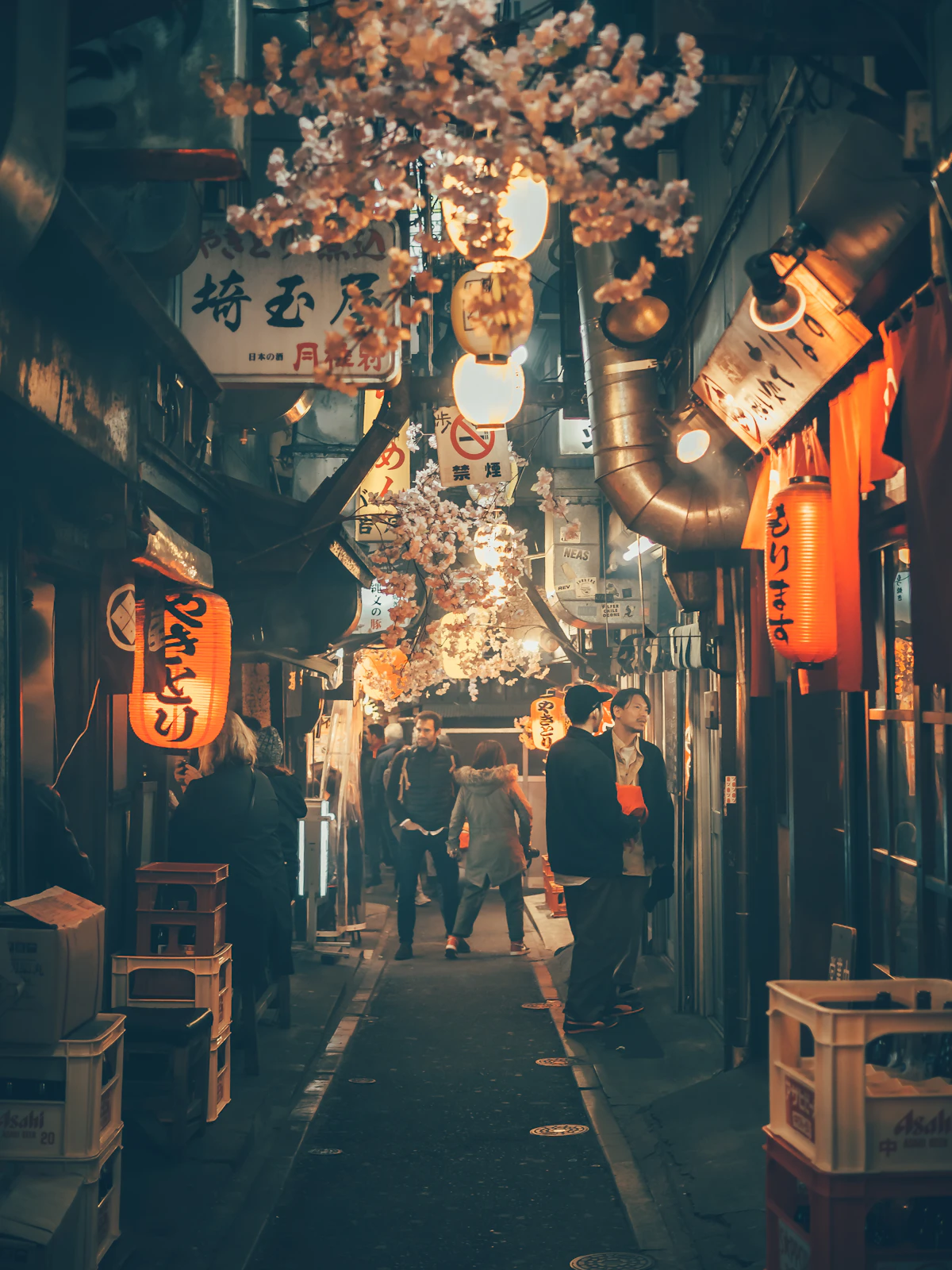
Shinjuku’s nightlife splits into two distinct zones separated by the station:
West side (西口):
- Omoide Yokocho — yakitori alley. Food-first, drinking second. Best for dinner (6–9 PM).
East side (東口/歌舞伎町):
- Golden Gai — 200+ tiny bars in six narrow alleys. Drinking culture, conversation, themed bars.
- Kabukicho — Japan’s largest entertainment district. Karaoke, game centers, restaurants, clubs, and the red-light area.
- Izakaya clusters — chain and independent izakayas along Yasukuni-dori and the streets behind.
The walk from Omoide Yokocho (west exit) to Golden Gai (east side) takes 10 minutes through the station or 15 minutes walking around it.
Omoide Yokocho: Where to Start Your Night

Omoide Yokocho (思い出横丁, “Memory Lane”) is a maze of ~80 tiny eateries tucked right outside Shinjuku Station’s west exit. Most shops have 6–10 counter seats. The smell of charcoal smoke hits you before you see the alleys.
What to Eat
| Food | Price | What It Is |
|---|---|---|
| Yakitori (焼き鳥) | ¥150–¥300/skewer | Grilled chicken skewers — get the tsukune (meatball) and negima (thigh with leek) |
| Motsuyaki (もつ焼き) | ¥150–¥250/skewer | Grilled organ meats. Adventurous but authentic. Try the hatsu (heart) |
| Ramen | ¥800–¥1,000 | Ramen Nagi in the alley is excellent. Rich tonkotsu broth |
| Beer | ¥500–¥700 | Draft beer (nama biiru). Asahi, Kirin, or Sapporo depending on the shop |
| Sake/Shochu | ¥400–¥700 | House pour. Ask for “osusume” (おすすめ, “your recommendation”) |
How to Order
Most shops here don’t have English menus. Here’s what to say:
You: “Sumimasen” (すみません — “Excuse me”) Point at what others are eating — this works surprisingly well. Or say: “Yakitori, go-hon kudasai” (焼き鳥、5本ください — “5 yakitori skewers, please”) For beer: “Nama, hitotsu” (生、ひとつ — “One draft beer”)
Payment: Cash only at most stalls. A few accept credit cards but don’t count on it.
When to Go
- Before 7 PM: Easy seating, relaxed atmosphere
- 7–9 PM: Peak time, expect to wait or stand
- After 10 PM: Thins out. Some shops close by 11 PM, others stay open until late
Budget for Omoide Yokocho: ¥2,000–¥3,500 per person for food and 2–3 drinks.
Golden Gai: The 200-Bar Maze

Golden Gai (ゴールデン街) is six narrow alleys packed with over 200 bars, each seating 5–8 people. Post-war wooden buildings, two stories, neon signs, and more personality per square meter than anywhere in Tokyo.
The Cover Charge System
Almost every Golden Gai bar charges a cover charge (チャージ, chaaji) of ¥300–¥1,000. This is standard in Japan — not a tourist trap. The cover charge pays for your seat, a small snack (otoshi/お通し), and the bar’s overhead.
| Bar Type | Cover Charge | Drink Prices | Total for 2 Drinks |
|---|---|---|---|
| Budget bars | ¥300–¥500 | ¥500–¥700 | ¥1,300–¥1,900 |
| Standard bars | ¥500–¥800 | ¥700–¥1,000 | ¥1,900–¥2,800 |
| Premium/themed bars | ¥800–¥1,000 | ¥800–¥1,200 | ¥2,400–¥3,400 |
Expect to spend ¥2,000–¥3,500 per bar for 2–3 drinks.
Which Bars Welcome Foreigners
Not all Golden Gai bars welcome walk-ins, especially foreigners. Here’s how to read the signals:
✅ Go in:
- English sign or menu visible outside
- Door is open and you can see inside
- Bartender makes eye contact and nods
- Sign says “Welcome” or “Tourists OK”
❌ Don’t enter:
- Sign says “Members Only” (常連のみ / 会員制)
- Door is closed with no window
- Bartender avoids eye contact or waves you away
- No visible menu or price list
Respect the “Members Only” sign. These bars survive on regular customers. Forcing your way in ruins the experience for everyone.
Bars Known to Welcome Foreign Visitors
- Albatross G — Two floors, Gothic interior, fits small groups. English-speaking staff. Cover ¥700
- Deathmatch in Hell — Horror/punk theme. Skull decorations. Fun and friendly. Cover ¥500
- La Jetee — Named after the French film. Arthouse crowd. Owner speaks English and French
- OPEN BOOK — Literature-themed. Bookshelves line the walls. Quiet and intellectual
- Bar Plastic Model — Exactly what it sounds like. Gundam models everywhere. Owner loves explaining them
Golden Gai Etiquette
- Don’t take photos inside a bar without asking. Ask the bartender first: “Shashin ii desu ka?” (写真いいですか? — “Is it OK to take a photo?”)
- Don’t photograph patrons — especially regulars who value privacy
- One drink minimum. You’re in someone’s tiny bar. Order something.
- Don’t stand in the alleys blocking traffic. The lanes are barely 1 meter wide
- Don’t bar-hop too fast. Sit, talk, have 2 drinks. The conversation IS the experience
- Tip: Go solo or in pairs. Groups of 4+ can’t fit in most bars
When to Visit Golden Gai
- 8–9 PM: Bars start opening. Good time to arrive
- 10 PM–midnight: Peak atmosphere. Most bars are full and lively
- After midnight: Some bars serve until 3–5 AM, but the crowd thins
- Before 8 PM: Most bars are closed
Kabukicho: Safety Guide
Kabukicho (歌舞伎町) is Japan’s largest entertainment district. It contains karaoke halls, game centers, cinemas, restaurants, clubs, love hotels, and host/hostess bars. The main streets are safe and well-lit. The back alleys require street sense.
What’s Safe
- Kabukicho Tower (Tokyu Kabukicho Tower) — Opened 2023. 48 floors of entertainment: Zepp Shinjuku (live music), namco game center, 109 Cinemas Premium, hotels, and restaurants. Completely legitimate and tourist-friendly.
- Karaoke chains — Karaoke Kan, Big Echo, Joysound, Manekineko. All on the main streets. Safe, fun, no issues.
- Game centers — SEGA, Taito Station. Clean, well-lit, family-friendly until late.
- Chain restaurants and izakayas — Torikizoku, Watami, Kin no Kura. Standard and predictable.
- Don Quijote Shinjuku — The giant discount store on Yasukuni-dori. Open 24 hours. Tax-free shopping for tourists.
What to Avoid
Street touts (客引き, kyakuhiki). This is the #1 danger in Kabukicho for tourists. Here’s how it works:
- A person approaches you on the street, often speaking English: “Hey, looking for a bar? I know a great place.”
- They lead you to an unlicensed bar where drinks cost ¥5,000–¥50,000 each
- You get a bill for ¥30,000–¥100,000+ at the end of the night
- Some use intimidation to force payment
The rule is simple: never follow anyone who approaches you on the street. Walk past without engaging. Don’t say “no thank you” — don’t say anything. Legitimate bars and clubs have fixed menus and prices posted outside.
The “Bottakuri Bar” Scam
Bottakuri (ぼったくり) means “rip-off.” These bars target tourists and drunk patrons:
- Tout invites you to a “cheap” bar
- No menu or prices shown
- Women sit with you and order expensive drinks on your tab
- Bill arrives: ¥50,000–¥200,000
- Bouncers block the exit until you pay
How to avoid it: Only enter bars you chose yourself. Check for visible price lists. If there’s no menu, leave immediately.
If it happens to you: Call the police (110). Tokyo Metropolitan Police has cracked down on bottakuri bars — the 2024 anti-solicitation ordinance in Kabukicho increased penalties. You are not obligated to pay fraudulent charges.
Robot Restaurant: It’s Closed (Here’s What Replaced It)
The famous Robot Restaurant permanently closed in July 2020. It’s not coming back.
What replaced it: Samurai Restaurant Time now operates in the same Kabukicho location. It features a similar over-the-top performance show with samurai and dancer themes. Tickets: ¥9,000–¥10,000 (includes meal and drinks). Book online in advance.
Is it worth it? If you loved the idea of Robot Restaurant, Samurai Restaurant Time captures similar energy. It’s tourist-oriented and unapologetically flashy. Not authentic Japanese culture — but entertaining.
Alternative for something more real: Skip the show restaurants. Spend that ¥10,000 on Golden Gai (3–4 bars) + Omoide Yokocho (dinner). You’ll have a better night and actual conversations with locals.
Karaoke: How It Actually Works

Japanese karaoke means private rooms, not singing on a stage in front of strangers. You rent a room by the hour, order drinks from a tablet, and sing with your group.
Karaoke Chains in Shinjuku
| Chain | Location | Rate (per person/hour) | English Songs | Notes |
|---|---|---|---|---|
| Karaoke Kan (カラオケ館) | Kabukicho, multiple locations | ¥300–¥600 (varies by time) | Yes, large selection | The one from “Lost in Translation” is on Sanchome |
| Big Echo (ビッグエコー) | Kabukicho main street | ¥400–¥700 | Yes | Clean, modern rooms. Free drink bar plans available |
| Joysound (ジョイサウンド) | Near east exit | ¥300–¥550 | Yes | Best machine for English song variety |
| Manekineko (まねきねこ) | Kabukicho | ¥200–¥450 | Yes | Budget option. Bring your own food/drinks allowed |
How to Book a Room
- Walk into any karaoke chain. No reservation needed (weeknights). Weekend nights after 10 PM may require a wait.
- At the front desk, say: “Futatsu no hito, ni-jikan” (2人、2時間 — “Two people, two hours”)
- They’ll hand you a room key and a tablet for drink orders
- Nomihoudai (飲み放題, all-you-can-drink) plans are ¥1,500–¥2,500 per person for 2 hours. Almost always the best deal.
- English interface: Press the language button on the karaoke machine (usually a globe icon). Search by song title or artist in English.
Budget: ¥2,000–¥4,000 per person for 2 hours with drinks (nomihoudai plan).
Karaoke Tips
- Peak pricing: Friday/Saturday after 10 PM rates are 2–3x daytime rates. Go before 7 PM for the cheapest rates.
- Free time plans (フリータイム): Available late night (~midnight–5 AM) at some chains. ¥1,500–¥2,500 for unlimited hours. Great if you missed the last train.
- Solo karaoke is normal in Japan. Many chains have “hitokara” (ひとカラ) rates for solo singers.
Izakaya: The Third Option
If Golden Gai feels intimidating and Omoide Yokocho feels too touristy, izakayas are the comfortable middle ground. Shinjuku has hundreds.
Chain Izakayas (Safe, Cheap, Late)
| Chain | Price Per Person | Hours | What to Know |
|---|---|---|---|
| Torikizoku (鳥貴族) | ¥2,000–¥3,000 | Until 4 AM | Everything ¥360. Chicken specialist. Best value in Shinjuku |
| Kin no Kura (金の蔵) | ¥2,000–¥3,500 | Until 5 AM | ¥299 appetizer menu. Touch-panel ordering |
| Uotami (魚民) | ¥2,500–¥4,000 | Until 5 AM | Seafood focus. Good sashimi. Nomihoudai from ¥1,500 |
| Watami (和民) | ¥2,500–¥4,000 | Until 5 AM | All-round menu. English menus available |
How to Order at an Izakaya
See our full izakaya ordering guide for the complete walkthrough. The short version:
At the door: “Ni-mei desu” (2名です — “Two people”) First order must be drinks. It’s tradition. Say: “Toriaezu, nama futatsu” (とりあえず、生ふたつ — “Two draft beers to start”) Then food: Point at the menu or use the tablet. Most chain izakayas have photo menus or touch-panel ordering with English.
The otoshi (お通し): A small appetizer that appears automatically. It costs ¥300–¥500 per person. This is the table charge — you can’t refuse it. It’s Japan-wide standard, not a scam.
Last Train: Don’t Miss It
The last train from Shinjuku Station runs around 12:20–12:35 AM on most lines. After that, you’re stuck until 5:00 AM.
Last Train Times from Shinjuku (Approximate)
| Line | Direction | Last Train (Weekday) | Last Train (Fri/Sat) |
|---|---|---|---|
| JR Yamanote (inner loop) | Shibuya → Shinagawa | ~12:26 AM | ~12:56 AM |
| JR Yamanote (outer loop) | Ikebukuro → Ueno | ~12:29 AM | ~12:59 AM |
| JR Chuo Line | Kichijoji → Mitaka | ~12:35 AM | ~1:05 AM |
| Tokyo Metro Marunouchi | Ikebukuro/Ogikubo | ~12:12 AM | ~12:12 AM |
| Toei Oedo Line | Various | ~12:08 AM | ~12:08 AM |
Set an alarm for midnight. That gives you 20–30 minutes to walk to the station and find your platform. Shinjuku Station is a labyrinth — factor in 10 minutes to navigate it. See our Shinjuku Station navigation guide.
Use a transit IC card to make it faster. Tap your Suica and run through the gates. Tourists: get a Welcome Suica (28-day, no deposit) at the airport.
Missed the Last Train? Your Options
Don’t panic. Thousands of people miss the last train in Shinjuku every night. Here’s the playbook:
Option 1: Karaoke Until First Train (Best Value)
Book a free time plan (フリータイム) at Manekineko or Karaoke Kan from midnight to 5 AM. Cost: ¥1,500–¥2,500 per person. You get a room, drinks, and a place to sit. Nap between songs.
Option 2: Manga Cafe / Net Cafe
Kaikatsu CLUB (快活CLUB) near Shinjuku east exit has reclining seats, showers, free drinks, and manga. Night pack (midnight–8 AM): ~¥1,500–¥2,500. Flat-seat rooms are more comfortable than booths.
Option 3: Capsule Hotel
Nine Hours Shinjuku (ナインアワーズ) and Anshin Oyado (安心お宿) are clean, modern capsule hotels near the station. Price: ¥3,000–¥5,000 for a walk-in night stay. Includes shower and locker. Book on the spot if available.
Option 4: Taxi
Taxi from Shinjuku to major areas:
- Shibuya: ~¥1,500–¥2,000
- Ikebukuro: ~¥2,000–¥3,000
- Tokyo Station: ~¥3,000–¥4,000
- Roppongi: ~¥2,500–¥3,500
Late-night surcharge (10 PM–5 AM) adds 20%. Use the GO or S.RIDE app to book — no need to flag one down.
Option 5: Stay Out
Golden Gai bars serve until 3–5 AM. Don Quijote is open 24 hours. Some ramen shops near the east exit are open all night. The first train is at 5:00 AM. You’ll survive.
Pitfalls: What Goes Wrong
”The tout seemed friendly, so I followed him”
No. Never. Not even once. If someone approaches you on a Kabukicho street offering a bar, club, or “girls,” walk away immediately. Legitimate venues don’t need street recruiters. The friendly ones are the most dangerous — they’re trained to be disarming. Call 110 (police) if someone physically blocks you.
”I got a ¥50,000 bill at a bar”
You went to a bottakuri bar. Call the police. Do not pay. The Shinjuku Police Station (新宿警察署) is in Kabukicho — 3 minutes from the main gate. Officers have dealt with this thousands of times.
”Golden Gai felt unfriendly”
You probably walked into a regulars-only bar. Try bars with English signs, open doors, or visible menus. Albatross, Deathmatch in Hell, and La Jetee are consistently welcoming to foreigners.
”I missed the last train and couldn’t find a capsule hotel”
Weekend nights (Friday/Saturday), capsule hotels near Shinjuku fill up by 1 AM. Book by midnight on your phone. Or go straight to a karaoke free-time plan — those always have availability.
When Things Go Wrong
| Problem | Cause | Solution |
|---|---|---|
| Charged an outrageous bar bill | Bottakuri (rip-off) bar | Call 110 (police). Don't pay. Go to Shinjuku Police Station in Kabukicho. Officers speak basic English. |
| Golden Gai bar refused entry | Members-only bar or full capacity | Respect it. Try the next bar. 200+ options. Look for open doors and English signs. |
| Can't find Omoide Yokocho | It's hidden next to the station | Exit Shinjuku Station west exit, turn left. It's behind the Uniqlo building, under the train tracks. Google Maps "思い出横丁" for the pin. |
| Phone dying / no cash | Long night, no plan | ChargeSPOT portable batteries at every convenience store (¥150/30 min). ATMs in every 7-Eleven (international cards accepted 24 hours). |
| Missed last train, no hotel | Lost track of time | Karaoke free-time plan (¥1,500–¥2,500 until 5 AM). Or manga café night pack. First train resumes at 5:00 AM. |
FAQ
Q: Is Golden Gai safe for solo travelers?
A: Yes, and it’s actually better solo. Most bars seat 5–8 people. Solo visitors fit easily, and the bartender will talk to you. Pairs are fine too. Groups of 4+ won’t fit in most bars.
Q: Is Kabukicho safe for women?
A: The main streets are well-lit and safe. Avoid following anyone into back-alley bars. The host clubs along the side streets are aggressive with solicitation — just walk past. Stick to the well-lit main roads, karaoke chains, and the Kabukicho Tower complex. Same rules as any nightlife district worldwide.
Q: Can I do Golden Gai without speaking Japanese?
A: Yes. Many bars have English-speaking bartenders or at least basic English menus. Albatross, Deathmatch in Hell, La Jetee, and OPEN BOOK all cater to international visitors. Point, smile, and say “beer please” — it works.
Q: How much cash should I bring?
A: ¥10,000–¥15,000 for a full night (dinner + 3–4 bars + karaoke). Golden Gai and Omoide Yokocho are mostly cash-only. Karaoke chains accept credit cards. If you run out, 7-Eleven ATMs accept Visa/Mastercard and are open 24 hours.
Q: What time should I arrive?
A: Start dinner at Omoide Yokocho around 6–7 PM, head to Golden Gai around 8–9 PM, and hit karaoke after 10 PM if you want. This pacing gives you the full experience without rushing.
Related Guides
- Shinjuku Station Navigation — find your exit in Japan’s busiest station
- How to Order at an Izakaya — the complete guide to Japanese pub etiquette
- How Payments Work in Japan — what to carry and what to say at the register
- Suica Card — tap through the gates. Tourists: get a Welcome Suica at the airport
- Shibuya & Harajuku — if you want a daytime plan before your Shinjuku night
Summary
- Start at Omoide Yokocho for dinner (6 PM), move to Golden Gai for drinks (8 PM). This is the ideal Shinjuku night arc.
- Never follow a street tout in Kabukicho. This single rule prevents 95% of tourist nightlife problems.
- Know your last train time (~12:30 AM) and have a backup plan. Karaoke free-time, manga cafés, or capsule hotels are all cheaper than a taxi.
Next step: Take the JR Yamanote Line to Shinjuku Station. Exit the west exit for Omoide Yokocho, or the east exit for Golden Gai and Kabukicho.