T R A N S P O R T
The Yamanote Line: Tokyo's Most Important Train, Explained
30 stations, 60-minute loop, 2-minute intervals. How to ride JR's green circle line — direction, key stations, rush hours, and Suica.
Quick Answer
- The Yamanote Line is a loop connecting Tokyo’s 30 biggest stations. Trains every 2–4 minutes. Full loop: 60 minutes. Runs ~4:30 AM to ~1:00 AM.
- Tap your Welcome Suica at the gate. Single ride: ¥150–¥210. No need to figure out the fare — Suica calculates automatically.
- Two directions: Clockwise (外回り) = Shibuya → Shinjuku → Ikebukuro. Counter-clockwise (内回り) = Shibuya → Shinagawa → Tokyo. Pick the shorter route.
- Key stations for tourists: Shinjuku (west side hub), Shibuya (shopping), Harajuku (fashion), Tokyo (Shinkansen), Ueno (museums), Akihabara (electronics).
- Avoid 7:30–9:30 AM on weekdays. Trains hit 180% capacity. You will be physically compressed.
- Commuter pass (定期券): If your commute uses Yamanote, buy a 1/3/6-month pass. Most employers cover the cost (通勤手当).
- Use Mobile Suica or PASMO on your phone. Auto-charge saves time.
- Rush hour survival: Board the middle cars (less crowded than ends). Women-only cars (女性専用車両) on some lines during morning rush.
- Last train: Check exact times for your station — varies between 0:00 and 0:50. Miss it → taxi or manga café until 5 AM.
- Takanawa Gateway (高輪ゲートウェイ) opened in 2020 between Shinagawa and Tamachi. The station area is still developing.
What This Guide Covers
✅ You’ll learn:
- How to ride the Yamanote Line with Suica (tap in, tap out, done)
- Which direction to take (and how to recover if you go the wrong way)
- Every key station and what’s there
- How to survive rush hour
⏱️ Time to learn: 5 minutes reading, a lifetime of use
💰 Cost: ¥150–¥210 per ride (Suica). ¥800 for a Tokunai Pass (unlimited JR in central Tokyo for one day)
⚠️ Watch out for:
- Going the wrong direction wastes 30+ minutes
- Rush hour (7:30–9:30 AM) is no joke — avoid if possible
- The Yamanote Line is JR, not Metro — different company, different gates
What Is the Yamanote Line?
The JR Yamanote Line (山手線) is a loop that circles central Tokyo, connecting 30 stations including Shibuya, Shinjuku, Ikebukuro, Ueno, Tokyo, and Shinagawa. It’s operated by JR East (Japan Railways).
Think of it as Tokyo’s backbone. Every other train line — Metro, Toei, private railways — connects to it somewhere. If you only learn one train line in Tokyo, make it this one.
The numbers:
- 30 stations, ~35 km loop
- Full circle: ~60 minutes
- Trains every 2–4 minutes during peak, every 4–5 minutes off-peak
- Operating hours: ~4:30 AM to ~1:00 AM
- Fare: ¥150–¥210 depending on distance (with IC card; paper tickets are ¥10 more)
- Daily riders: ~3.5 million (one of the busiest lines on Earth)
The color: Light green. On every map, every sign, every platform. If you see light green, you’ve found the Yamanote Line.
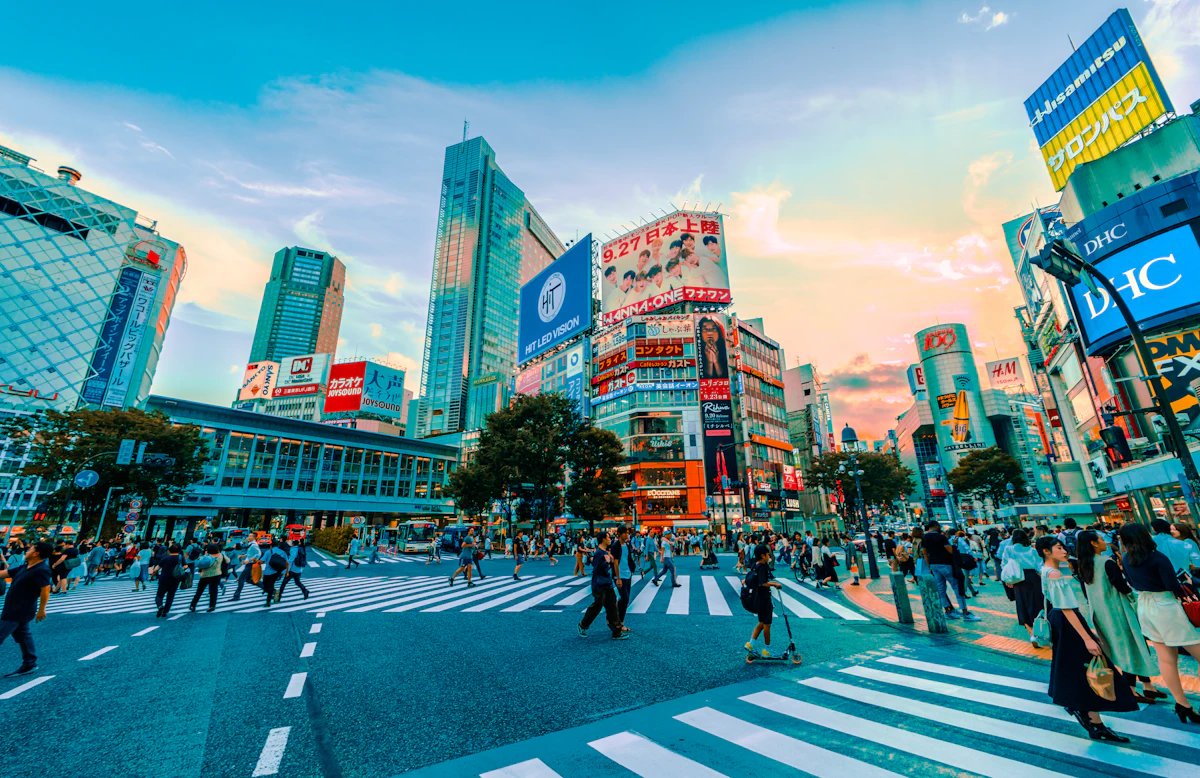
The Yamanote Line loops around the heart of Tokyo. Learn it, and you can get anywhere.
How to Ride: Suica Makes It Effortless
Step-by-Step
- Find a JR gate. Look for the green JR logo. Not the blue Tokyo Metro “M” — those are different gates for a different company.
- Tap your Suica/Welcome Suica on the card reader at the entry gate. You’ll hear a beep and the gate opens.
- Find the Yamanote Line platform. Follow signs for 山手線 (Yamanote-sen). The platform color is light green.
- Check the direction (see next section).
- Board. No need to pick a specific car — every car stops at every station.
- Get off at your station. Tap your Suica at the exit gate. The fare is deducted automatically.
That’s it. No fare calculation, no paper tickets, no confusion. Suica handles everything.
If You Don’t Have Suica
Buy a paper ticket at the ticket machines:
- Find the fare map above the machines (stations are listed with prices)
- Find your destination and note the fare
- Press the fare button, insert cash
- Collect your ticket, insert it into the gate slot
But seriously, just get a Suica. → Suica guide
What to Say at the Gate (If Something Goes Wrong)
- Gate beeps and closes → 残高不足です (zanndaka busoku desu) — “Insufficient balance.” Go to the nearest charge machine.
- English alternative: Show your Suica to station staff and say “charge, please” (チャージ, chāji). They’ll point you to a machine.
The Direction Trap: Clockwise vs. Counter-Clockwise
This is the #1 mistake tourists make on the Yamanote Line. There are only two directions, and picking the wrong one means riding 40 minutes instead of 10.
How It Works
- 外回り (sotomawari) = Clockwise (Outer Loop)
- Shibuya → Harajuku → Shinjuku → Ikebukuro → Ueno → Tokyo → Shinagawa → back to Shibuya
- 内回り (uchimawari) = Counter-clockwise (Inner Loop)
- Shibuya → Shinagawa → Tokyo → Ueno → Ikebukuro → Shinjuku → Harajuku → back to Shibuya
Quick Reference: Which Direction?
| From → To | Take | Why |
|---|---|---|
| Shibuya → Shinjuku | Clockwise (外回り) | 2 stations, 4 min |
| Shibuya → Tokyo | Counter-clockwise (内回り) | 7 stations, 20 min (vs. 23 stations clockwise) |
| Shinjuku → Ueno | Clockwise (外回り) | 8 stations, 20 min |
| Shinjuku → Shinagawa | Counter-clockwise (内回り) | 6 stations, 18 min |
| Tokyo → Ikebukuro | Counter-clockwise (内回り) | 8 stations, 22 min |
| Ueno → Shibuya | Counter-clockwise (内回り) | 10 stations, 25 min |
How to Check Direction on the Platform
- Look at the electronic display board above the platform
- It shows the next 2–3 stations in the direction the train is going
- If the first station listed is where you want to go (or on the way), you’re on the right platform
- If not, cross to the other platform
If you get on the wrong direction: Don’t panic. Get off at the next station, cross the platform, take the opposite direction. You won’t be charged extra — Suica only calculates entry and exit stations, and this is a loop.
Pro tip: Google Maps tells you which direction. Type your route, and it’ll say “Yamanote Line (Clockwise)” or “(Counter-clockwise).”
Every Station and What’s There
Here are the 30 Yamanote Line stations with what matters at each:
The Big 5 (You’ll Definitely Use These)
Shinjuku (新宿) — Japan’s busiest station. 3.5 million daily users. West side: skyscrapers, government buildings. East side: Kabukichō entertainment district. Transfers to: Chuo Line, Odakyu, Keio, Seibu, Metro Marunouchi/Fukutoshin Lines. → Shinjuku Station Navigation
Shibuya (渋谷) — Shibuya Crossing, Hachikō statue, shopping. Transfers to: Ginza Line, Hanzomon Line, Fukutoshin Line, Tokyu, Keio Inokashira Line.
Ikebukuro (池袋) — Department stores (Seibu, Tobu), Sunshine City, anime shops. Transfers to: Marunouchi Line, Yurakucho Line, Fukutoshin Line, Seibu, Tobu.
Tokyo (東京) — Shinkansen hub. Transfers to bullet trains for Kyoto, Osaka, Hiroshima, Tohoku. Also: Chuo Line, Marunouchi Line, Keiyo Line (to Tokyo Disney). → Near the Imperial Palace.
Ueno (上野) — Tokyo National Museum, Ueno Park and Zoo, Ameyoko market. Transfers to: Ginza Line, Hibiya Line, Keisei Skyliner to Narita Airport.
Tourist Favorites
Harajuku (原宿) — Takeshita Street (teen fashion), Meiji Shrine, Omotesando. One station from Shibuya.
Akihabara (秋葉原) — Electronics, anime, manga, gaming. Transfers to: Hibiya Line, Tsukuba Express.
Shinagawa (品川) — Shinkansen stop. Transfers to: Keikyu Line (to Haneda Airport). Major hotel area.
Nippori (日暮里) — Transfer to Keisei Skyliner for Narita Airport. Also near Yanaka, a charming old-Tokyo neighborhood.
Hamamatsucho (浜松町) — Transfer to Tokyo Monorail for Haneda Airport.
Other Notable Stations
Takanawa Gateway (高輪ゲートウェイ) — Newest station (opened 2020). Between Shinagawa and Tamachi. The surrounding development includes shops and a robot-staffed convenience store.
Yurakucho (有楽町) — Walking distance to Ginza. Good izakaya under the tracks (ガード下).
Tamachi (田町) — Close to Tokyo Tower. Transfers to Toei Mita Line and Toei Asakusa Line.
Osaki (大崎) — Transfer to Rinkai Line (to Odaiba/Tokyo Big Sight for Comiket).
Tabata (田端) — Quiet residential. Transfer to Keihin-Tohoku Line.
Numbered floor markings show exactly where the doors will open. Line up behind them.
Rush Hour: When to Ride and When to Avoid
The Peak
Weekday mornings 7:30–9:30 AM: Trains run at 180–200% capacity. This means physical body compression. Your bag will be pressed against your chest. You will not be able to move your arms.
Weekday evenings 5:30–8:00 PM: Crowded but slightly less intense than mornings.
How to Survive Rush Hour
- Shift by 30 minutes. Riding at 7:00 AM or 10:00 AM is dramatically better than 8:30 AM.
- Board middle cars. End cars (near stairs/escalators) are the most packed. Middle cars have more room.
- Remove your backpack. Hold it at your feet or in front of your chest. A backpack on your back takes up double the space and annoys everyone.
- Don’t block doors. Move to the center of the car. People exit and enter from the doors — blocking them causes delays and earns you glares.
- Women-only cars (女性専用車両): Available on some lines during morning rush. Marked with pink signs. Men should not board these cars during designated hours.
Off-Peak Sweet Spots
- 10:00 AM – 4:00 PM: Comfortable. Always a seat.
- After 9:00 PM: Thinning out. Occasional drunk salarymen.
- Weekends: Less crowded overall, but tourist areas (Harajuku, Shibuya) are busy.
Train Etiquette: Don’t Be That Tourist
Japanese trains have unwritten rules. Break them and you’ll get silent disapproval — which, in Japan, is the worst punishment.
The Rules
| Do | Don’t |
|---|---|
| Set phone to manner mode (マナーモード) | Talk on the phone |
| Give up priority seats to elderly, pregnant, disabled, injured | Sit in priority seats when the train is empty (grey area, but safer to stand) |
| Line up behind floor markings | Cut the queue |
| Move to the center of the car | Block the doors |
| Hold your backpack in front | Wear backpack on your back during rush hour |
| Keep conversations quiet | Talk loudly |
| Eat and drink on the platform, not the train | Eat on the train (Shinkansen is OK, commuter trains are not) |
What to Say If You Need Help
- “Sumimasen” (すみません) — “Excuse me” — works for everything
- “[Station name] wa doko desu ka?” — “Where is [station name]?”
- Show station staff your destination on Google Maps — they’ll help you
Connections: Where Yamanote Meets Everything Else
The Yamanote Line is a hub that connects to virtually every other line in Tokyo.
Airport Connections
| Airport | Transfer Station | Line |
|---|---|---|
| Narita (via Skyliner) | Nippori or Ueno | Keisei Skyliner |
| Narita (via N’EX) | Tokyo, Shinagawa, Shibuya, Shinjuku | JR Narita Express |
| Haneda (via Keikyu) | Shinagawa | Keikyu Line |
| Haneda (via Monorail) | Hamamatsucho | Tokyo Monorail |
→ Full guide: Airport to City Center
Shinkansen (Bullet Trains)
- Tokyo Station: Tokaido (Kyoto/Osaka), Tohoku, Joetsu, Hokuriku Shinkansen
- Shinagawa Station: Tokaido Shinkansen (same trains, fewer people)
- Ueno Station: Tohoku, Joetsu, Hokuriku Shinkansen
Metro and Toei
Almost every Yamanote station connects to at least one Metro or Toei line. Use your Suica seamlessly — just follow the transfer signs and tap through the connecting gates.
→ Full guide: Tokyo Metro Navigation
The Tokunai Pass: Unlimited JR for One Day
If you’re hitting multiple Yamanote stations in one day, the Tokunai Pass (都区内パス) saves money:
- Price: ¥760 for adults, ¥380 for children
- Coverage: Unlimited rides on JR lines within Tokyo’s 23 wards (including the entire Yamanote Line, plus Chuo Line, Sobu Line, Keihin-Tohoku Line, and more)
- Where to buy: JR ticket machines at any station
- When it saves money: If you’d spend more than ¥760 on JR rides in one day (roughly 4+ rides)
Troubleshooting
| Problem | Cause | Solution |
|---|---|---|
| Went the wrong direction | Didn’t check platform display | Get off at next station, cross platform, ride back. No extra charge with Suica. |
| Gate beeps red, won’t open | Low Suica balance | Charge at nearest machine. Minimum ¥1,000. |
| Missed last train (~1:00 AM) | Lost track of time | Taxi (¥2,000–¥5,000 within central Tokyo), manga café (¥1,500–¥2,000 for a night), or karaoke until 5 AM first train. |
| Can’t find the right platform | Station is huge (especially Shinjuku, Shibuya) | Follow green 山手線 signs. Ask any station staff — say “Yamanote Line, please.” |
| Train is impossibly crowded | Rush hour | Wait for the next train (2–3 min). Or walk to the middle of the platform where it’s less packed. |
FAQ
Q: Can I ride the Yamanote Line with a JR Pass?
A: Yes. The JR Pass covers all JR lines including the Yamanote. Just show your pass at the manned gate (not the automatic gates, unless you have the IC card version of the JR Pass).
Q: How do I know which exit to take?
A: Station exits are labeled by compass direction (North, South, East, West) or by name (Hachikō Exit at Shibuya, Marunouchi Exit at Tokyo). Google Maps shows which exit is closest to your destination. Check before you leave the platform.
Q: Is the Yamanote Line the same as Tokyo Metro?
A: No. The Yamanote Line is JR (Japan Railways). Tokyo Metro is a completely separate company with separate stations and gates. Your Suica works on both, but you’ll pass through different ticket gates. Transferring between JR and Metro means exiting one gate and entering another.
Q: What happens if I fall asleep and ride past my stop?
A: You’ll just keep going around the loop. Worst case: you ride an extra 50 minutes back to your station. No penalty, no extra fare — Suica charges based on entry and exit stations only.
Q: Are there express trains on the Yamanote Line?
A: No. The Yamanote Line is all-stops only. Every train stops at every station. You can’t accidentally get on an express.
Related Guides
- How to Get and Use Suica — Essential for riding any train
- Airport to City Center — Getting to the Yamanote Line from the airport
- Tokyo Metro Guide — The subway system that connects to Yamanote
- Shinjuku Station Navigation — Survive Japan’s busiest station
- Tokyo Metro Transfers — Moving between JR and Metro smoothly